IGLU
Integrated Gaussian Linear Unit
TL;DR
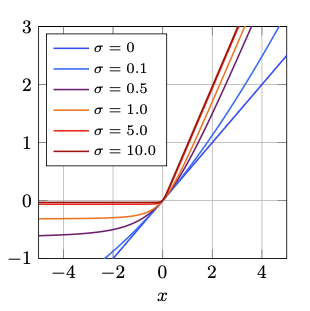
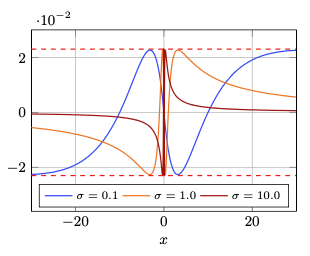
IGLU: Integrated Gaussian Linear Unit is a parametric activation function derived as a scale mixture of GELU gates under a half-normal distribution. This derivation yields a closed-form expression whose gating component is exactly the Cauchy CDF, providing a principled one-parameter family that continuously interpolates between identity-like and ReLU-like behavior via a single sharpness parameter $\sigma$. Unlike GELU’s Gaussian gate, IGLU’s heavy-tailed Cauchy gate decays polynomially in the negative tail, guaranteeing non-zero gradients for all finite inputs and offering greater robustness to vanishing gradients.
Paper
IGLU: The Integrated Gaussian Linear Unit Activation Function
Mingi Kang, Zai Yang, Jeova Farias Sales Rocha Neto
Bowdoin College
Available on arXiv: 2603.06861
Key Contributions
- Derives IGLU as a continuous scale mixture of GELU gates under half-normal distribution
- Gating component equals Cauchy CDF—guarantees non-zero gradients for all finite inputs
- IGLU-Approx: efficient rational approximation using only ReLU operations (no transcendental functions)
- Demonstrates strong performance on balanced and especially imbalanced datasets
- Provides theoretical unification of ReLU and GELU via single parameter $\sigma$
Integrated Gaussian Linear Unit
First recall the definition of GELU:
\[\text{GELU}(x) = x \cdot \Phi(x), \Phi(x) = \int_{-\infty}^{x} \frac{1}{\sqrt{2\pi}} e^{-\frac{t^2}{2}} dt\]Since GELU follow the gated-linear form $x \cdot g(x)$, we can introduce a configurable parameter $a$ that scales or sharpens the gate, producing parameterized variants:
\[\text{GELU}_a(x;a) = x \cdot \Phi(a x)\]As $a$ approaches infinity, the function converge to ReLU, and as $a$ approaches zero, the function converge to a scaled identity function.
Rather than a single parameter level $a$, we can introduce it as a latent scale variable and average over a continuum of gating strengths:
\[\text{IGLU}(x; \sigma) = \int_{0}^{\infty} \text{GELU}_a(x; a) f(a;\sigma)da,\]where $f(a;\sigma)$ is a non-negative weighting function parameterized by $\sigma > 0$. This formulation allows the activation function to adaptively integrate information across a range of gating strengths, potentially enhancing its expressiveness and performance in neural networks.
Now, when we choose $f(a;\sigma)$ to be a half-normal distribution with mean zero and standard deviation $\sigma$, the integral becomes:
\[Z(x; \sigma) = \int_{0}^{\infty} \Phi(a x) \cdot \frac{\sqrt{2}}{\sigma \sqrt{\pi}} e^{-\frac{a^2}{2\sigma^2}} da,\]where $\text{IGLU}(x; \sigma) = x \cdot Z(x; \sigma)$.
To solve this integral, we expand $\Phi(ax)$ and substitute $t = ax$:
\[Z(x;\sigma) = \frac{2x}{\sqrt{2\pi}\,\sigma} \int_0^\infty e^{-a^2/2\sigma^2} \int_{-\infty}^{x} \frac{a}{\sqrt{2\pi}}\, e^{-a^2 s^2/2}\, ds\, da.\]We then swap the order of integration and solve the inner integral:
\[= \int_0^\infty a\, e^{-a^2\left(\frac{1}{\sigma^{2}} + s^2\right)/2} da = \frac{1}{\sigma^{-2} + s^2} = \frac{\sigma^2}{1 + \sigma^2 s^2},\]which leads to the closed-form solution for $Z(x; \sigma)$:
\[Z(x;\sigma) = \frac{\sigma x}{\pi} \int_{-\infty}^{x} \frac{ds}{1 + \sigma^2 s^2} = \frac{1}{2} + \frac{\arctan(\sigma x)}{\pi},\]and thus the final closed-form expression for IGLU is:
\[\text{IGLU}(x; \sigma) = x \cdot Z(x; \sigma) = x \left( \frac{1}{2} + \frac{\arctan(\sigma x)}{\pi} \right)\]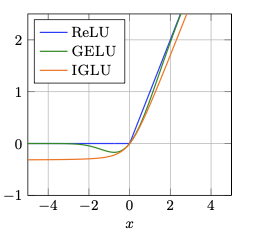
Integrated Gaussian Linear Unit Approximation
The approximation for the arctangent function:
\[\arctan(x) \approx \frac{\pi}{2} \cdot \frac{\sigma x}{1 + |\sigma x|},\]which is continuous, odd, and saturates correctly as $x \to \pm \infty$. Substituting into the original gating function yields:
\[Z_{\text{approx}}(x; \sigma) = \frac{1}{2} \frac{1 + 2\max(0, \sigma x)}{1 + |\sigma x|} = \frac{1}{2} \frac{1 + 2\text{ReLU}(\sigma x)}{1 + \text{ReLU}(\sigma x) + \text{ReLU}(-\sigma x)},\]where we used the identities $x + \lvert x\rvert = 2\max(0, x)$ and $\lvert x\rvert = \max(0, x) + \max(0, -x)$.
This approximation maintains the same asymptotic behavior as the original function while being computationally more efficient to evaluate.
Therefore, the final approximation for IGLU is:
\[\text{IGLU}_{\text{approx}}(x; \sigma) = x \cdot Z_{\text{approx}}(x; \sigma) = \frac{x}{2} \cdot \frac{1 + 2\text{ReLU}(\sigma x)}{1 + \text{ReLU}(\sigma x) + \text{ReLU}(-\sigma x)}\]Computational Efficiency
IGLU-Approx benchmarks (relative to Identity function):
- CPU Forward: 10.17× (vs GELU: 16.40×)
- GPU Forward: 15.05× (vs GELU: 15.36×)
- Competitive with ReLU while preserving smooth gradient flow
- No transcendental function evaluation required
Citation
@article{kang2026iglu,
    title={IGLU: The Integrated Gaussian Linear Unit Activation Function},
    author={Kang, Mingi and Yang, Zai and Neto, Jeova Farias Sales Rocha},
    journal={arXiv preprint arXiv:2511.XXXXX},
    year={2026}
}